
The Double Embodiment: Carbon, Memory, and What Old Buildings Still Do
What old mills, Rajasthani havelis, and a London power station can teach us about circularity


Author’s note: I've always been fascinated by heritage buildings and by the question of how we preserve their beauty without stripping them of purpose. This piece is my attempt to explore that tension, and to unpack how repurposing old buildings might be one of circularity's quietest ideas.
“The greenest building is the one that is already built.” — Carl Elefante, architect
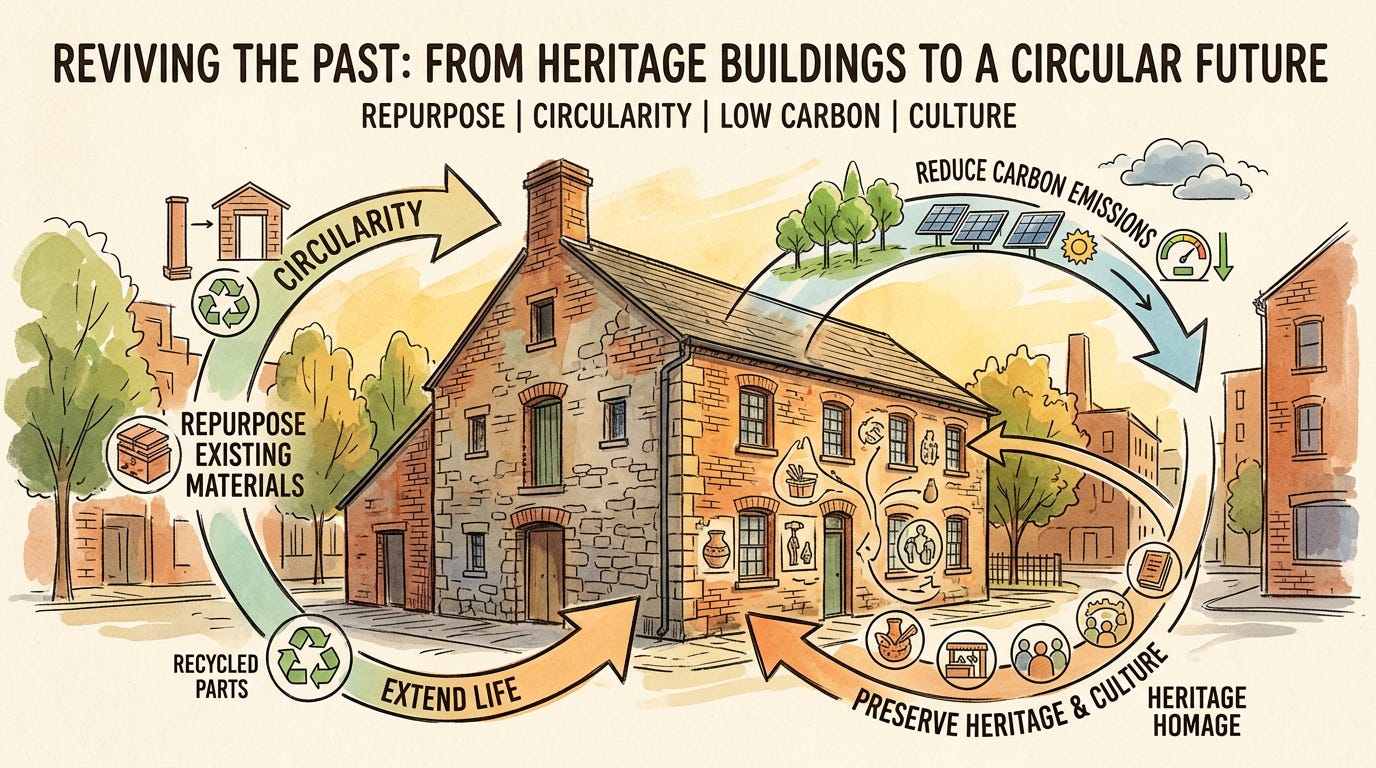
You might have celebrated a promotion at Lower Parel’s poshest bars, eaten at the fine-dine spots you’ve screenshotted for a “someday” list, or spent a birthday at one of the gaming lounges — a lot of it sits inside Girangaon, Mumbai’s old “village of mills.” The same brick shell that once employed 250,000 workers a day during the 1960s and 70s is just wearing a different outfit now. At Kamala Mills, the original facades are still standing exactly as they were built — the outside hasn’t changed. What changed is everything happening inside it. Nobody demolished the place. Somebody just figured out it had more left to give.
Turns out that’s not a Mumbai quirk. It’s one of the biggest, quietest climate wins available to us, and almost nobody talks about it that way.
These cultural heritage buildings, which today might be serving a different purpose, carry memories, culture, and rich history. These buildings hold a unique niche in the urban landscape. They provide shelter and embody the local cultural and historical characteristics that define communities.
These structures serve as physical connections to the past, offering insight into traditional building techniques, cultural practices, and aesthetic values of previous generations. In addition to their historical significance, heritage buildings contribute to a place’s identity, social cohesion, and economic development through cultural tourism and urban regeneration. The UNESCO World Heritage Convention recognizes built heritage as a fundamental component of cultural identity that warrants protection for future generations. Apart from the cultural and historical significance, these buildings also hold a key to circularity through adaptive reuse and repurpose!
India’s cities are already sitting on some of the most compelling adaptive reuse opportunities in the world — if only we choose to see them that way.
In Delhi, the story of Dhan Mill Compound is equally instructive. R.K. Jain invested in a property in South Delhi and launched a paddy field storage facility around 1960, which soon became a wholesale grain distribution hub. After running at a loss for more than six years, the facility was transformed into a creative hub, built around a business strategy that served a diverse market — catering to the fashion industry while also functioning as a hub for urban design communities. What was once a warehouse and granary is now one of the most aesthetically vibrant, chic places for Delhiites to shop, eat, and explore the work of some of the finest artists and designers. The brick walls and industrial bones of a grain store became the character that no new building could replicate.
The State of Rajasthan also offers great examples of adaptive reuse of old, culturally rich havelis adorned with intricate frescoes and architectural splendour. For decades, many of these havelis stood abandoned — too expensive to maintain, too significant to demolish, and too beautiful to ignore.
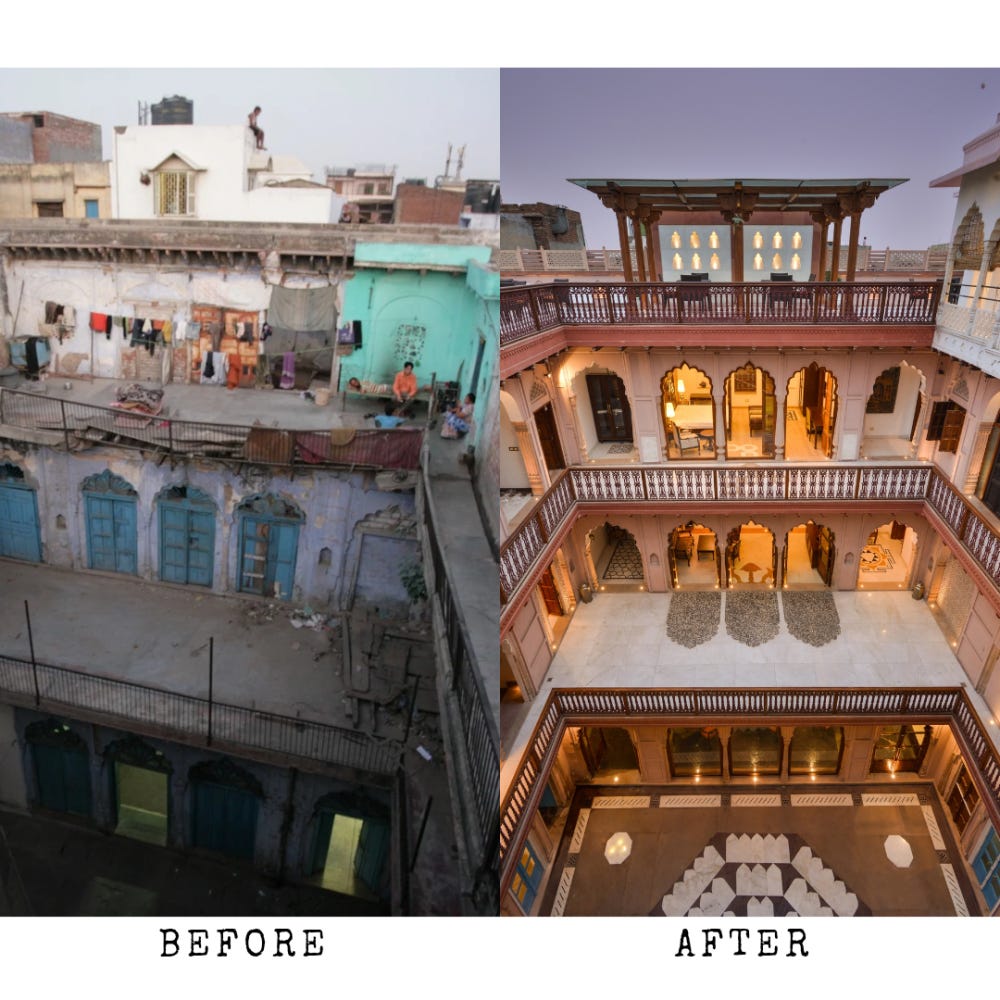
Several havelis in the Shekhawati region, comprising districts like Jhunjhunu, Sikar, and Churu, have been meticulously restored and converted into heritage hotels, retaining original architectural elements such as courtyards, frescoes, and jharokhas (the overhanging enclosed balconies) while incorporating modern amenities. Mandawa Castle, built in 1755, now serves as a luxury heritage hotel where guests explore richly decorated rooms whose walls are adorned with paintings depicting British colonisers, Indian kings, and mythological scenes. This is just one example among many such heritage properties restored and converted into hotels, attracting thousands of tourists from around the world.
In case this reads like an India-only trend: London did it too, at serious scale.
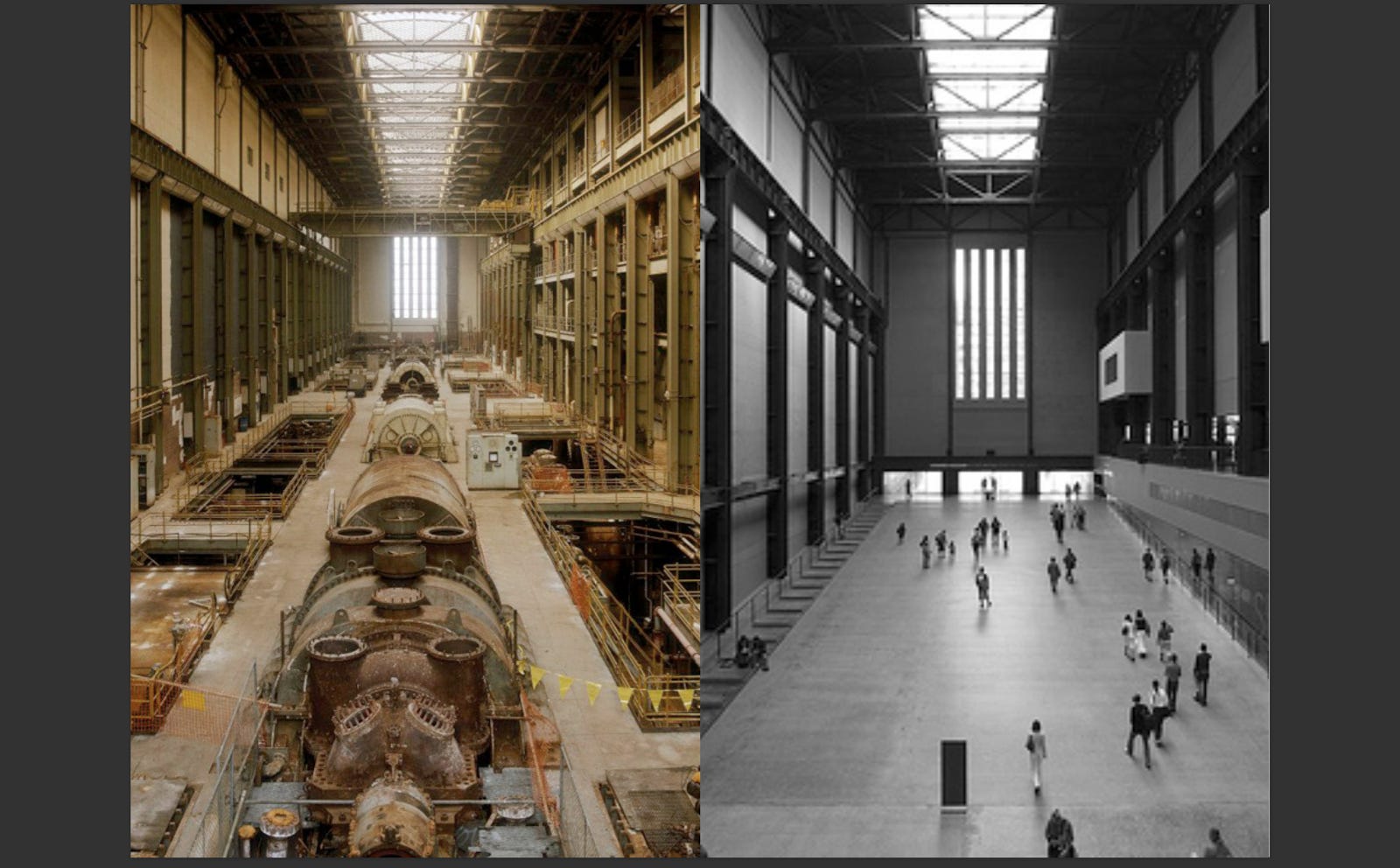
Tate Modern used to be a power station. When Herzog & de Meuron redesigned it in 2000, they didn’t erase what it used to be — they leaned into it. The chimney stayed. The brick facade stayed. The Turbine Hall, once packed with machinery generating electricity for half of London, is now one of the most dramatic public art spaces on Earth. The building didn’t need to pretend it had always been a gallery. It just needed someone willing to ask what it could become, instead of what should replace it.
This is a piece about two things that turn out to be the same thing: carbon and memory. The carbon case is measurable — in emissions saved, waste diverted, landfill avoided. The cultural case is harder to put a number on, but just as real — in the craft traditions, neighbourhood identity, and collective memory that a preserved building carries forward. A good question to ask is why and how our historical heritage can unlock both of these gains — and whether it already has. We try to answer that here.
The carbon case: what demolition really costs
The case for repurposing historical buildings presents a compelling argument for carbon emissions abatement. The construction sector generates a staggering amount of waste. In the US alone, 600 million tonnes of construction and demolition debris were produced in 2018 — and demolition accounts for over 90% of that figure, with most of it ending up in landfills. The EU generated 820 million tonnes over the same period, while China now exceeds 2 billion tonnes annually. Concrete waste alone makes up over 60% of this global total.
Yet less than a third of all construction and demolition waste is currently recovered and reused. The construction industry contributes more than a third of global emissions, and despite growing awareness, over 75% of construction waste worldwide still isn’t repurposed — with annual volumes projected to climb to 2.2 billion tonnes this year.
These staggering numbers point us towards a compelling question: can repurposing or restoring historical buildings actually replace some of the new planned construction, without compromising on the design, strength, and utility of the space?
The numbers don’t lie: adaptive reuse vs new construction
Reusing buildings saves 50-70% of the embodied carbon that new construction would generate. The National Bureau of Economic Research reported that conversions have about 75% less embodied carbon than new construction. A study across twenty adaptive reuse projects in Saudi Arabia found they had 55.5% lower total embodied carbon compared to new construction, with this advantage more than offsetting a 13.8% increase in operational energy, yielding 6.1% lower overall life-cycle carbon.
The catch (because there’s always a catch)
None of this is a clean, easy win, and it’s worth saying so plainly.
Old buildings come with structural baggage — columns, floor layouts, load-bearing walls that were never designed with your new plan in mind. There’s a real tug-of-war between preservation and performance: conservation principles push for minimal intervention and keeping things authentic and reversible, while making a building genuinely sustainable often means tearing into its envelope and systems in ways that aren’t gentle at all. And then there’s the unglamorous stuff — materials that actually match what’s already there aren’t always easy to source, and workers who still know the old techniques aren’t always easy to find.
Adaptive reuse also isn’t automatically cheaper or faster than starting fresh, and it shouldn’t be treated as sacred by default. Some buildings really are too far gone structurally. Some sites genuinely have better uses. Getting precious about heritage for its own sake is its own kind of blind spot.
Circularity is both material and cultural
The more closely you examine the best examples of adaptive reuse, the more the two lenses of this blog — carbon and culture — collapse into one. Tate Modern didn’t just save the embodied carbon of a power station’s brick and steel; it saved the industrial identity of Bankside. The havelis of Rajasthan didn’t just avoid the emissions of new construction; they kept alive the craft traditions of lime mortar and lakhori brick. The Kamala Mills compound didn’t just preserve a facade; it preserved a neighbourhood’s memory of itself.
This is what makes circularity in the built environment distinctive. When a building is repurposed, both the material and the meaning survive. The reuse of heritage buildings saves embodied energy and adapts historical buildings for contemporary use, delivering social, environmental, and fiscal benefits that reintegrate life into historical contexts.
The policy moment is beginning to catch up. 29% of cities setting circular economy targets have specifically focused on buildings and infrastructure, with targets to reduce virgin material use, maximise reuse, and design for deconstruction. Frameworks like the WEF Model Policy on Adaptive Reuse and the Circular Cities Declaration are giving municipal governments the tools to make preservation the default rather than the exception.
The case for repurposing historic buildings is compelling — but not unconditional, for the reasons above.
What the evidence does support, though, is a shift in the default. The majority of buildings that will exist in 2050 have already been built. Given that reality, demolition should be the exception that requires justification — not preservation. Tate Modern, the havelis of Rajasthan, and the mill compounds of Mumbai succeeded not because adaptive reuse is always easy, but because someone was willing to do the harder, slower work of asking what a building could become before asking what could replace it.
So, demolish or don’t?
Given that most of 2050’s buildings are standing right now, the honest answer is: demolition should be the thing that needs justifying — not the other way around.
Tate Modern, the havelis of Rajasthan, the mill compounds of Mumbai — none of them got saved because adaptive reuse is easy. They got saved because someone was willing to do the slower, harder work of asking what a building could still become, before reaching for the wrecking ball.
Next time you’re sipping a cocktail in Lower Parel or attending a wedding in a 260-year-old palace, that’s not just a nice backdrop. That’s circularity, working quietly, one saved building at a time.
Sources
Written by Garima for I Will Circle Back.
If this piece resonated, hit the ❤️ or share it with someone you think would love this.
 |
|