
Practical Sustainability Part 2: The Curious Case of the Waste We Generate
Why cardboard in the trash still feels like a personal failure


Author’s note: In Part 1 of this series, I wrote about how small, practical choices — even in something as routine as travel — can quietly add up.
In this piece, I turn to something even more everyday: the waste we generate, and what happens to it after it leaves our homes.
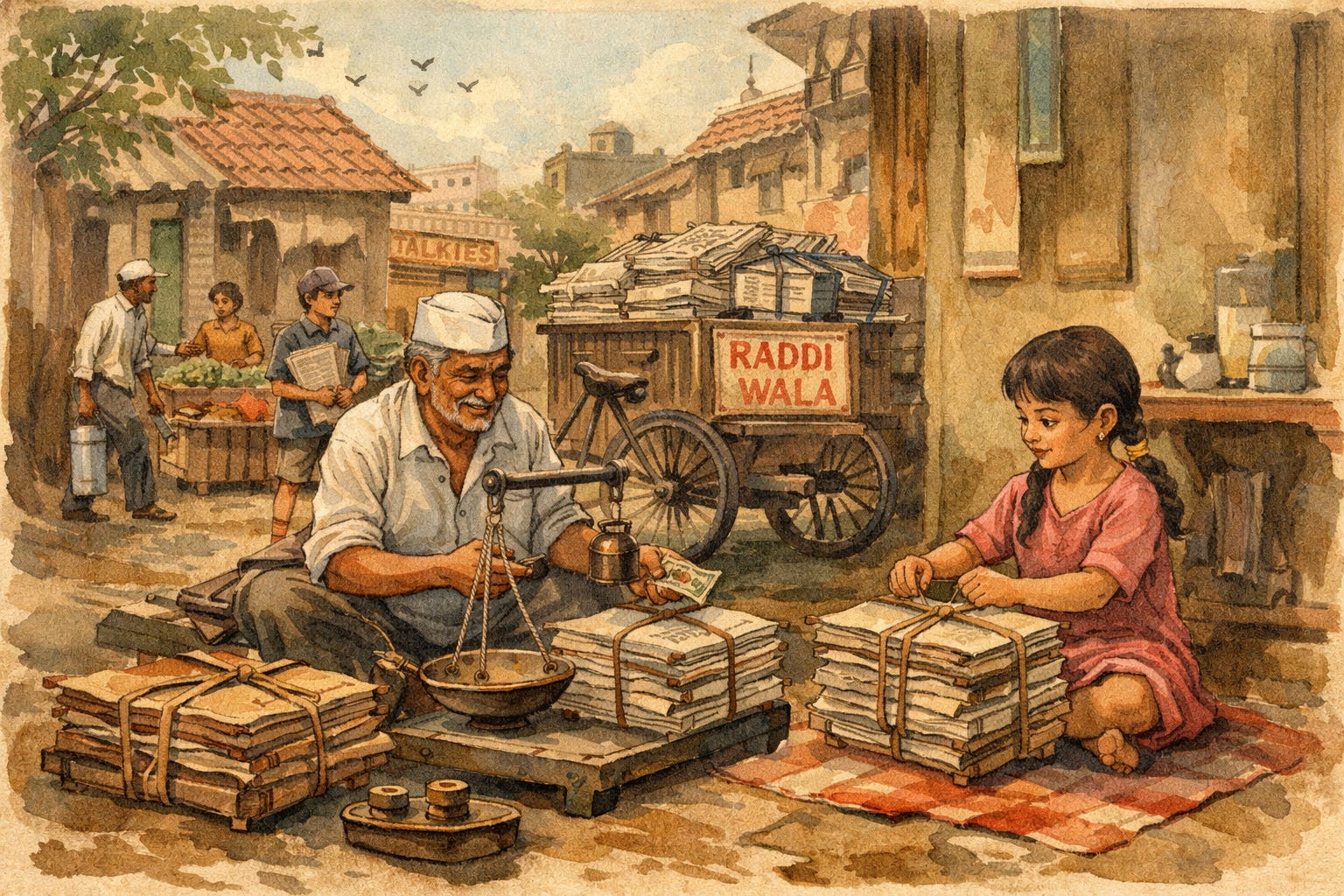
As a child growing up in the modest, unpolished suburbs of Mumbai — warm, well-meaning, and loosely organized in the most seamless way — life moved through familiar faces: the milkman, the newspaper boy, the trash picker, the vegetable vendors at our doorstep. And among these familiar faces was one who was less regular, but no less essential — the raddiwala (an Indian waste picker or scrap dealer who buys old newspapers, magazines, plastic, and metal directly from households for recycling)
Every morning after my dad finished reading the newspaper, it was my job to add the most recent one to the top of the stack. At the end of every other month, the raddiwala would come home. He would tie the newspapers and cardboard piles (the latter few and far between since it was a time before online shopping and quick commerce became the norm) with rope, weigh them and give us ₹10–15 per kilo. It was never about the money. Even then, I was more gratified by the knowledge that these items were moving on to a second life.
UK and Recyling beyond the raddiwala
Years later, when I moved to the UK, I was pleasantly surprised to see this happen at scale and not just with paper and cardboard.
Think scheduled pick up days, green bins for food waste, blue bins for paper, another for glass. While I missed the personal connection we had with our raddiwala, I was happy not to have to look for one myself in a foreign land.
It was the first time I had seen segregation of waste implemented in such an organized fashion and I loved being an enabler in the process. I would take segregation very religiously.
That was when appreciation for segregation became intentional for me. Until then, I had always viewed recycling as a natural consequence of usage, and hadn’t really noticed the personal responsibility involved, given the organic ecosystem we had growing up. That was the seed that later led me to experiment with composting back home. Having experienced both an informal system that worked and a formal one that supported it, I assumed segregation was simply how things were done.
California, the green illusion
Obviously, I expected the same when I moved to the US, specifically the Los Angeles county in California. In fact, one of the things I was excited about when moving to California was its reputation as a “green state” with its ambitious clean energy targets and waste laws such as SB 1383 mandating separation of organic waste from landfills.
Boy, was I in for a shock when I learned that the townhome where I was going to reside didn’t even segregate waste! “My hopes and dreams shattered” would be an understatement — and I don’t mean that dramatically. It happened stealthily.
When I visited friends in the Bay Area and witnessed an advanced level of waste segregation very similar to the UK, I sincerely hoped that level of development would eventually make its way to our neighborhood (less than 400 miles away) too, slowly but surely. Even cities much closer home, like Carlsbad, had segregation in place. In that hope, I started composting our own food waste.
But in this process, I realized that zero segregation had implications far beyond just food. And I couldn’t stop noticing.
When I went for walks, I would see trash bins overflowing with Amazon cardboard boxes, newspapers, juice cartons — filled up just a day after they were emptied. The one that stood out in sheer bulk was, of course, cardboard. Bulky and voluminous, it immediately caught attention.
The raddiwala experience, still vivid in my memory, made this feel wrong on so many levels — most importantly, how could this be trash?
It wasn’t even like food, which would eventually start smelling and therefore couldn’t be dealt with conveniently at an individual level. And considering cardboard packaging formed the bulk of most logistics, seeing it in the trash felt like a much larger problem — one that, at least in my head, felt too significant to ignore.
Denial of the obvious
Around the same time, I began hearing something else. Another school of thought.
My managing director once vehemently argued that recycling paper and cardboard is a waste of everyone’s time.
My ex-boss, when moving houses, had too many boxes and was worried he would be charged a disposal fee if he dumped them all in the trash. So he painstakingly distributed them across public trash cans. I kept wondering, how did recycling not occur as an option to him even once?
I couldn’t fathom the sentiment. Was it denial? Or did they genuinely believe recycling wasn’t environmentally efficient— thinking only about logistics costs and transport emissions? What about water consumption? What about deforestation?
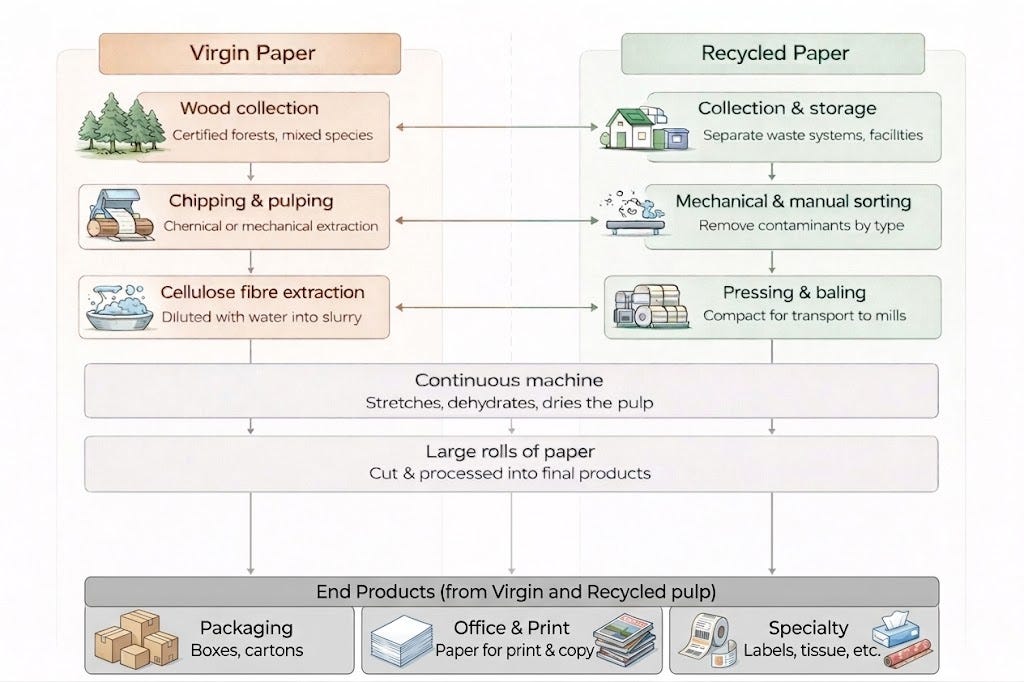
But their resistance kindled in me a curiosity to understand the process itself — how virgin paper is made versus how recycled paper comes to life again.
How Paper Is Made — And Remade
Here’s a quick snapshot of how virgin paper and recycled paper are made.
Recycling vs. Virgin Production: The Data Speaks
Once I understood the process, the resource difference became impossible to ignore.
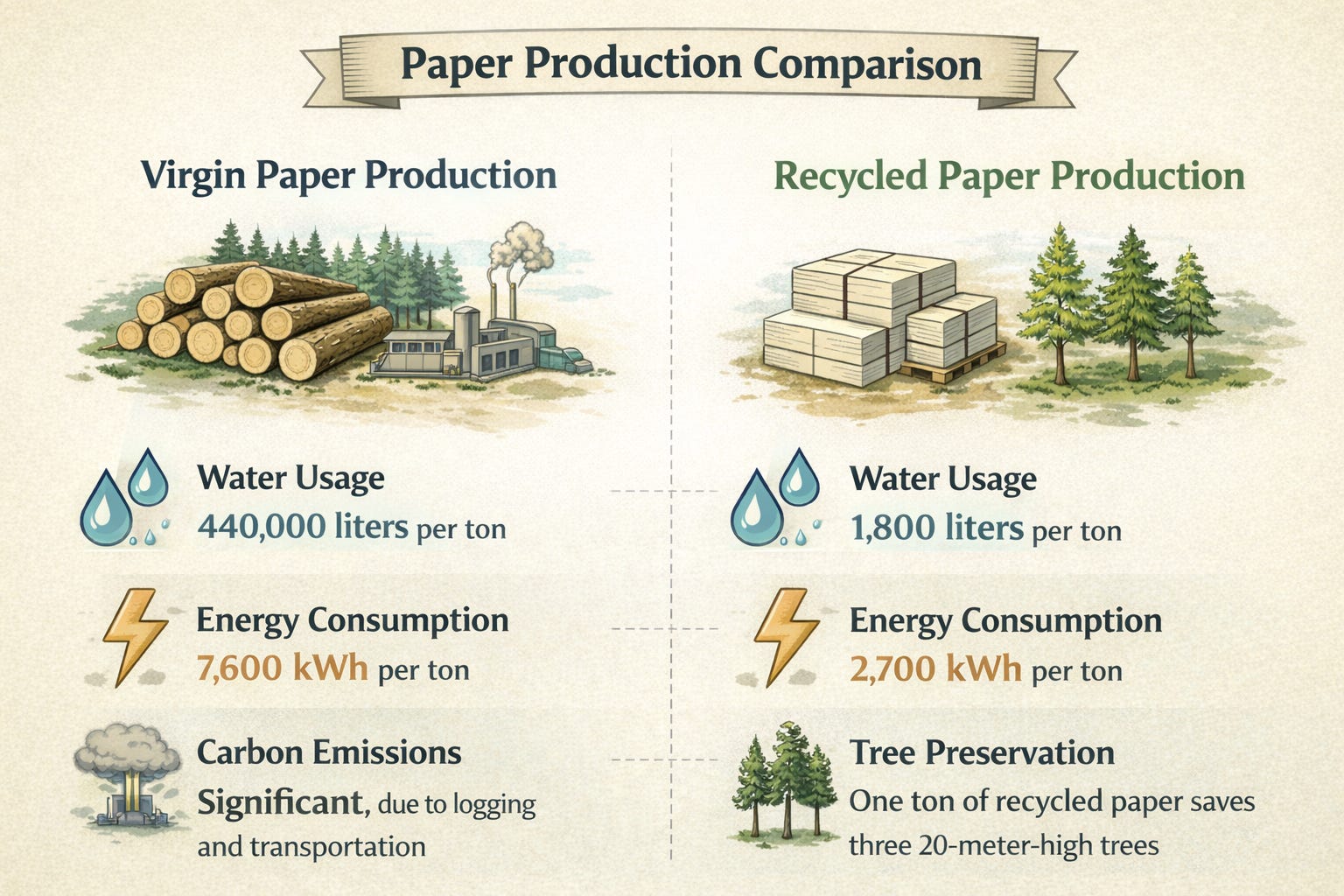
So, if every household recycled just 20 delivery boxes over six months (assuming an average of 1.5 lbs per box), that would be ~6k liters of water (i.e. 63 showers for an average person) saved and 67 kWh energy saved (2 days of power for a home)
Cost of Inconvenience or Lack of Segregation
Thanks to data and my upbringing, opposing arguments never discouraged me.
However, the process — and the onus shifting from the system to us — I must admit, did.
I couldn’t get myself to throw those boxes into the trash. I wasn’t wired that way.
So what did that mean for me?
Now every time we buy something and get it home, we flatten the packaging boxes ourselves. It’s a whole ritual - of removing the labels, peeling the tape as much as possible, and cutting them compactly.
It doesn’t make sense to make multiple trips to the recycler from a green perspective, so we wait until they balloon up just enough to fill the car.
Responsibility without infrastructure is labor.
If the ecosystem were better prepared, would it reduce our workload? Yes, it would.
The part about finding a recycler and making dedicated trips every few months - for sure, it would. The part about shredding boxes small enough so they don’t fill the garage - most definitely, it would. I would appreciate that support any day.
But that still doesn’t take away my responsibility of segregating and disposing of waste responsibly in the first place.
The Tougher Paper
It still kills me to throw thermocol or Styrofoam in the trash. Every time that happens, I wish companies would stop using it. Alternatives exist. Yet convenience persists.
As for me, I am yet to find a reliable recycler for these materials. Since they can’t be cut down to manageable sizes as easily as cardboard, it becomes onerous to store them until they become sizable.
If you’ve found a way to deal with this more responsibly — or have any hacks that work in practice — I would genuinely love to learn from you.
The Middle of Circularity
What makes me continue doing it?
The data
My upbringing
The fledgling but hopeful ecosystem
Some personal upsides — like the ability to DIY with cardboard boxes, or reuse them when moving houses instead of throwing them away.
Unlike clothes or food, where you can practice circularity at home, and unlike electronics, which need systemic help entirely, cardboard lies somewhere in the middle.
There is an ecosystem but it needs our love and support as much as we need theirs.
(BTW, we’ve been covering the circularity of consumer electronics at IWCB - in case you’d like to give it a read, here’s an essay you could try).
Who Is Doing It Better?
It was interesting to read how through awareness and infrastructure investment, Germany has achieved significant increases in recycling rate increases across the board, not just cardboard! But their success still relies on consumers not disposing recyclable material with residual waste.
South Korea and Japan mandate preparation steps at the household level before cardboard reaches recycling centers.
Where Does Your Cardboard Go?
Now you know where recycled cardboard goes. The question is not whether it has a second life. It does. The question is whether we allow it to have one. In Part 1 of this series, I wrote about how small, practical choices — even in something as routine as travel — can quietly add up. This feels no different. Because cardboard is not rare. It is not complex. It is not even hard to deal with — at least in theory. And yet, whether it gets a second life or ends in a landfill often comes down to small, everyday decisions. Where does your cardboard go? Where would you like it to go? And what small, practical step would you be willing to take to help cardboard have a second life — even when the system doesn’t make it easy? Perhaps the real shift begins when we stop accepting disposability as the default.
References
Written by Sangeetha for I Will Circle Back.
If this piece resonated, hit the ❤️ or share it with someone you think would love this.
 | A guest post by
|